
Though you’ve got quite a lot of freedom in a self-directed IRA, the IRS has a few specific exclusions. These are known as prohibited transactions and disqualified persons. Any transaction with a disqualified person is also a prohibited transaction and doing either within your IRA puts the tax status of your account at risk. Investing in real estate with your self-directed IRA is a lot like investing in real estate outside of your IRA, except the IRS prohibits a few things.
Prohibited Transactions
Specifically, there are a few types of investments, transactions, and situations prohibited by the IRS, known as prohibited transactions. They exist to prevent you and your IRA from having an unfair advantage over other investors and keep you from benefiting directly from the IRA at least until you’ve retired.
You now know that with a Self-Directed IRA, you’re able to invest in virtually anything. However, if it engages in prohibited transactions, you may jeopardize the tax-deferred status of your IRA account. The IRS doesn’t tell you what you can do, only what you can’t. For example, you can’t invest in life insurance or collectibles. Other prohibited transactions include:
- Works of art
- Metals or gems
- Alcoholic beverages
- Rugs or antiques
- Stamps
- Life Insurance
- Most coins
While you cannot invest in certain coins, you can invest in precious metals with your Self-Directed IRA.
Self-Dealing
A self-dealing prohibited transaction occurs when an individual uses his or her IRA income or assets for personal gains. Self-dealing is one of the most common prohibited transactions and this is when the IRA owner attempts to do business with themselves. This isn’t allowed. You can’t buy or sell the property to yourself, you can’t lend money to yourself from the IRA, and you can’t pay any IRA expenses or take any IRA income personally. You can’t use an IRA asset for personal benefit in any way, this is a prohibited transaction.
Examples of self-dealing include:
- Having your IRA purchase real estate that you own or use
- Have your IRA purchase real estate that is owned by a family member of lineal descent, such as your father, mother, children, etc.
- Lending money to a disqualified person
- Granting a child a second mortgage for the down payment on his or her first home
- Buying stock from the account owner involving IRA funds and a disqualified person
- Purchasing stock in a closely held corporation in which the account owner has a controlling equity position
- Purchasing restricted stock from a family member who is a disqualified person.
Sweat Equity
A sweat equity prohibition implies that you can’t do any work at all on the property, this is not something allowed with a self-directed IRA. No matter your expertise, no matter the size of the job. Any work you perform on or for the asset is prohibited. Often called sweat equity, it refers to any work you personally do on a property (the “sweat” refers to the effort spent to improve the investment, instead of paying an outside provider). So if you’re a contractor, you can’t fix a clogged toilet or leaky sink, that’s prohibited.
With a self-directed IRA, you (or a disqualified person) are not allowed to personally do any work on the property, no matter how big or small. Any repair, improvement, or maintenance must be performed by a paid, non-disqualified person to avoid any unfair advantage to your IRA investments. The IRS sees this money you saved by doing the work yourself as an indirect benefit, so you need to steer clear.
Disqualified Persons
Another prohibited transaction is the engagement of IRA funds with a disqualified person. The majority of Self-Directed IRA prohibited transaction rules pertain to transactions with disqualified persons. The reason that transactions with disqualified persons are prohibited is that the IRC views such dealings as suspicious, therefore should not be allowed.
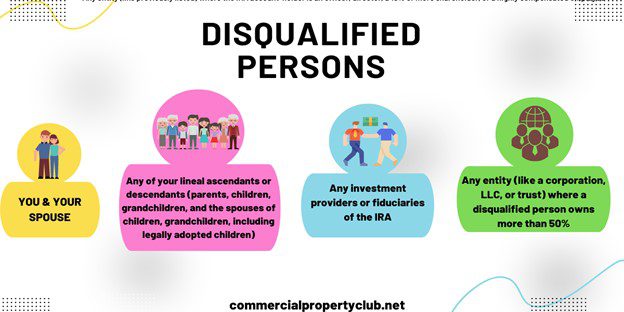
The definition of a disqualified person extends to a variety of scenarios that can be complex. There are specific individuals (known as disqualified persons) that the IRS forbids your IRA from engaging in transactions. Disqualified persons include the IRA holders and/or their lineal descendants. It also includes entities of which disqualified persons own 50%.
Any transaction with these individuals is a prohibited transaction with one exception when partnering on a new transaction, or you can lose the tax status of your account. Otherwise, if you don’t follow these rules, you’re putting your account at risk.
These rules are primarily in place so investments involving your IRA can benefit the retirement account, not just the account owner. Of course, when you reach retirement age, you will benefit by having an increase in funds in your account.
The Prohibited Transaction rules were created to encourage people to save for retirement and increase their retirement funds through tax-free or tax-deferred growth. However, it also prevents individuals from taking advantage of tax benefits for their personal accounts.
Conclusion
The IRS’ position is that your retirement fund is meant to benefit you when you retire, and not a moment before. Because of this, the IRS does not want investors to personally benefit from anything the IRA does. By disallowing specific transactions, they aim to enforce an “arm’s length” standard, where you are not directly working with or benefiting from your IRA.
Investing with a self-directed IRA could be exactly what your retirement needs to live the future you want, but you’ve got to follow the rules to get there. Being aware of the few things that aren’t allowed in your IRA is essential when it comes to protecting yourself and your account. Based on the growing number of self-directed investors each year, investors are finding ways to make excellent returns, despite the prohibitions.
As informed investors we should understand the risks associated with real estate investing and that there is no guarantee. Please do your due diligence.