The Texas economy continued to expand in July, with broad-based growth in payrolls. Job openings remained elevated, and the unemployment rate ticked down. It was indicated that expansion slowed in the service and manufacturing sectors, and sales contracted in the retail sector. Median home prices cooled in July, while existing-home inventories increased.
Texas ranks fourth for the current economic climate and first for its growth prospects, thanks to strong employment and income growth forecasts for the next five years. In addition, there are over 100 of the 1,000 largest public and private companies in the U.S. based in Texas, including giants like AT&T, ExxonMobil, and Dell. Entrepreneurial activity ranks fourth in the nation, per the Kauffman Foundation. One of the only things holding Texas back is the education rate among its labor supply. Only 84% of adults have a high school degree, which is the second lowest among the states.
Financial Activity
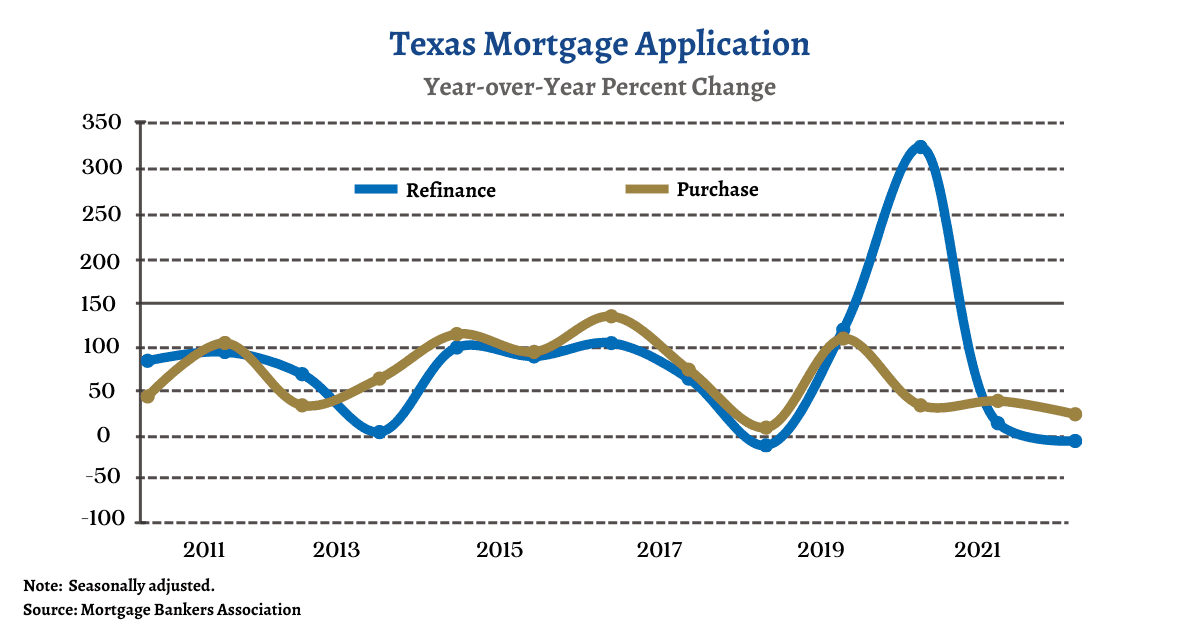
The Federal Reserve cut the federal funds rate over 9 fold to 0.77 percent in a bid to tighten the money flows in the economy this year. Bond yields and mortgage rates are affected greatly by monetary policies. The ten-year U.S. Treasury bond yield rose 114 basis points to 2.9 percent, and the Federal Home Loan Mortgage Corporation’s 30-year fixed-rate increased by half to 5.23 percent proportionately. The median mortgage rate within Texas increased in April to 4.4 and 4 percent for government-sponsored enterprise and non-GSE loans, respectively.
Many borrowers veered away due to the increase in interest rates. Data provided by TrueStandings Servicing showed that the broader context where total new loan counts and the original loan balances fell around 70 percent and 45 percent MOM, respectively, for GSE and non-GSE mortgagees.
The table below shows the data profiles. (In comparison with April 2020’s metrics, see Finding a Representative Interest Rate for the Typical Texas Mortgagee.)
Data Profiles of GSE, Non-GSE Mortgagees
April 2022
| GSE Borrower | Non-GSE Borrower | |
| DTI | 36.75 | 35.74 |
| LTV | 85.56 | 82.38 |
| Loan Count | 799 | 801 |
| Loan Balance | $298,679 | $377,115 |
| Interest Rate | 4.4% | 4% |
Source: TrueStandings Servicing
Housing
In February, indicators of Texas residential construction activity varied but remained elevated compared with pre-pandemic levels. The five-month moving average of single-family housing permits increased 1.7 percent in February, while housing starts (including multifamily construction) expanded 6.8 percent. Residential contract values were flat. In February, single-family housing permits and residential contract values were up 16.5 percent and 5.9 percent, respectively, from year-ago levels.
Record home prices and rapidly rising mortgage rates continued to push potential buyers, particularly first-time buyers, out of the market for homeownership. In July, housing supply increased in most major Texas metros but remained well below the six months considered a balanced market
Employment
Texas employment expanded an annualized 6.2 percent in May, greater than April’s 5.2 percent increase and above the U.S. rate of 3.1 percent. Job growth was mostly broad-based, apart from the oil and gas and education and health services sectors. The Texas unemployment rate dipped to 4.2 percent in May but remained above the U.S. figure (3.6 percent), in part due to stronger labor force growth in the state. The number of Texans filing initial unemployment insurance claims decreased for the second consecutive month to 55,500 in May
Year to date through May, Texas payrolls increased an annualized 5.6 percent (298,400 jobs), with gains in nearly all sectors outpacing those in the U.S. Over the five-month period, growth was strongest in the energy sector (19.1 percent), buoyed by high oil and gas prices
In the largest sector (trade), the Texas economy added 158,500 jobs between January 2021 and April 2022. In the second largest sector (professional and business services), the state economy added 174,100 jobs. In the third largest sector (government), the state economy added 29,900 jobs. The state’s unemployment rate fell from 6.7 percent in January 2021 to 4.3 percent in April 2022. Initial claims for Unemployment Insurance in Texas fell 80 percent since The quit rate, a measure of labor market strength (since people generally quit jobs to take better jobs), rose from 2.6 percent in January 2021 to 3.1 percent in March 2022.

Construction
The construction industry is one of the largest and fastest-growing in Texas. There are 763,000 people employed by the industry, constituting 5% of the total nonfarm workforce. Construction of buildings is the leading sub-industry driving this growth, with multifamily housing starts outpacing single-family starts and permit volume. Amidst the industry’s overall expansion, 1,100 workers were recruited in Houston alone for building construction, suggesting a surging construction demand in the local economy. Commercial construction is also trending positively, though infrastructure spending has been limited.
Construction is fueled by population growth, an improving housing market, and a healthier business investment environment. Construction payrolls increased by 10,600 jobs, the sharpest monthly increase this year. Average hourly construction earnings went down to $29.2 per hour, declining 4.29 percent YOY after adjusting for inflation.
Energy
Texas’ energy market had major activities despite the shrinking of the energy payroll. The energy sector dismissed 600 workers after about seven months of steady growth. Crude oil production in Texas rose to five million barrels per day in April after active rigs shot up by 28 to a seasonally adjusted rate of 314. The West Texas Intermediate (WTI) crude oil spot price climbed to its highest level to an average of $118 per barrel, jumping 65.2 percent YTD. Prices of natural gas disheveled the market with the Henry Hub spot price soaring to $8.2 per million British thermal units (BTU), doubling the year-end price.
Services
This year, added 58,000 employees were added to the Texas service-providing sector to bring the total level to 11.4 million workers. Accommodation/food services employment steered the monthly gain, 26,000 workers were hired, followed by professional/scientific/technical services (7,600). Respondents to communicated Decelerated service activities were communicated by the Dallas Fed’s Service Sector Outlook Survey amidst the falling revenue index. The perception of broader business conditions was mostly unchanged, the future index fell into the negative territory for the first time in the past two years.
Trade
Global inflation was fueled by various factors. The Russia-Ukraine war disrupted supplies of global energy while the spring COVID outbreak in China elongated the lead time and conveyance of commodity exports with quarantined factory workers and collapsed port traffic. The Texas trade-weighted value of the dollar had been on the decline since January. In March 2022, Texas reported export trade amounting to $42.1 billion, an increase over the $28.3 billion in trade exports reported in March 2021.
Texas reported a March 2022 year-to-date export trade of $112.4 billion, versus $80.5 billion year to date in March 2021. Texas is also outperforming the export trade output of the four next largest states combined, according to BEA data. Texas’s year-to-date export trade, at $112.4 billion, was greater than the combined $109.4 billion of the next four largest states: $45.4 billion for California; $25.6 billion for Louisiana; $20.3 billion for New York; and $18.1 for Illinois. Texas’ crude oil exports skyrocketed in real terms and hit peak demand at a nominal rate of $10.1 billion. Texas’ manufacturing exports increased 4.1 percent YTD, while national exports shrank 2.2 percent.

As informed investors we should understand the risks associated with real estate investing and that there is no guarantee. Please do your due diligence.
How does the Texas economy compare to other states?
What are some of the challenges facing commercial real estate investors in Texas?
One of the biggest challenges facing commercial real estate investors in Texas is increased competition, as more investors are drawn to the state’s strong economy and growing population. Additionally, rising property values and construction costs can make it more difficult to find profitable deals.