Using information from the federal government’s consumer price index, the Federal Reserve Bank of Dallas forecasts that the annual growth in rental prices would increase from 5.8% in June 2022 to 8.4% in May 2023.
Similarly, Thomas LaSalvia, director of economic research at the financial analytics company, forecasts a rent growth rate of 5% to 7% during that same period in a forthcoming Moody’s Analytics prediction. Annualized rent price increases were between 4% and 5% before the Covid epidemic, he claims.
In order for the Fed to get inflation back into its target range in the next six months, interest rates are expected to need to increase, according to LaSalvia. “And as a result, mortgage rates will remain fairly high.”
Fortunately for renters, Moody’s anticipates a slowdown in a price increase in the second half of 2023, pending a decrease in the cost of mortgage borrowing.
There is also a belief that the Fed would change course and stop raising interest rates once inflation starts to decline, which would ease some of the pressure on the mortgage market, according to LaSalvia. Renters should benefit from a price break as a result, he claims.
Hale from Realtor.com says tenants should be prepared to pay extra in the meantime. If it’s affordable, tenants might wish to extend their current lease to save money. She suggests that tenants consider renting in the suburbs, where rent growth has been less than in cities.
Last but not least, according to Hale, tenants may be able to save money by sharing a larger apartment with another person because the price rise of studio apartments has surpassed that of one- or two-bedroom homes.
The rental market in Atlanta
While researchers predict that rental costs will rise once more this year, the increase will likely be less pronounced than in recent years.
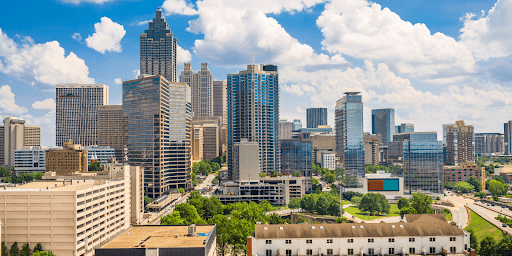
Rent in Atlanta was, on average,  less expensive towards the end of 2022 than the pricing from precisely one year earlier, according to a Rent.com analysis. The report asserts that Atlanta is the only significant city in the Southeast to have had a year-over-year reduction in prices rather than an increase.
According to a different analysis by Apartment List, prices in Atlanta fell on average by 1.4% between 2021 and 2022, making it one of 22 major American cities to experience this trend. According to this survey, just two of the 22 rated cities—Atlanta and Virginia Beach, Virginia—were in the southeast.
Additionally, this year appears bright for renters who want to purchase their first house. According to the NAR estimate, a higher percentage of Atlantans than the US as a whole will be able to buy a home there: more than 20%.
According to Rittenberg, the city’s declining rental costs have given tenants a greater opportunity to decide between purchasing and staying in a rental.
According to Rittenberg, “First-time homebuyers can still benefit from home ownership at a time when rents are only $1,529 on average.” “The buy-versus-rent option is still very profitable even with today’s interest rates.”
APARTMENT MARKET RENT GROWTH 1ST QUARTER 2023 REPORT
 For the multifamily industry, the tide has been progressively turning. The rent burden increased while economic development and household formation slowed, eventually tamping down the “pandemic fever” that was formerly stoked by reduced rental prices and migration. Over the previous few quarters, multifamily demand has significantly decreased, and in the first quarter of 2023, net absorption even briefly fell below zero. However, given that the early trend’s net move-out estimates were so low, we wouldn’t be shocked if the situation changed after additional construction data was validated and backfilled over the following several weeks.
Given several interrelated variables, including as the cooling of the single-family home market, a robust job market, and solid household real income growth, we continue to be cautiously optimistic regarding multifamily demand. Although leasing was subpar, construction activity was at an all-time high. It is anticipated that projects started in 2021 and early 2022, when rent growth was high and financing costs were low, would be finished this year and the year after. However, due to high borrowing costs and a minor increase in supply chain stress, first-quarter delivery was slow. To finish Q1 at 4.71%, the vacancy rate increased 13 basis points (bps). The current vacancy rate has surpassed the pre-pandemic level of 4.68% thanks to this largest increase over the previous two years.
Rent decreases expanded more widely in the first quarter compared to year-end 2022, with 60 key metros seeing negative market rent increases ranging from -0.1% to -6.4%. At the national level, asking and effective rent decreased by 1% and 0.9%, respectively. This helped level off renters’ rent burden and will eventually make its way through to tame housing inflation in the headline CPI. Asking and effective rent increase decreased from over 17% in Q2 2022 to just under 6% this quarter on an annual basis.
As informed investors, we should understand the risks associated with real estate investing and that there is no guarantee. Please do your due diligence.