
Opportunity Zones are a mechanism for economic development that let investors put money into struggling American neighborhoods. Its goal is to promote economic development and job creation in low-income areas while giving investors tax advantages.
Low-income census tracts are nominated by governors and certified as Opportunity Zones by the U.S. Department of the Treasury to encourage economic development and job creation. Investors are encouraged to invest in Opportunity Zones in exchange for certain federal capital gains tax benefits.
HOW DO “OPPORTUNITY ZONES” WORKS FOR COMMERCIAL REAL ESTATE?
Opportunity Zones, a new federal incentive included in the Tax Cuts and Jobs Act, are designed to encourage investment in underfunded communities. Every business or person with capital gains is eligible. Unrealized capital gains have three tax advantages when invested in Opportunity Zones under the program:
- Deferral Of Capital Gains Taxes For A Certain Time. Existing assets with capital gains can be invested in Opportunity Funds by investors. These current capital gains are not subject to taxation until 2026 ends or the asset is sold.
- Increase In The Basis Of Previously Accumulated Capital Gains. Investors’ basis on the initial investment rises by 10% for capital gains held in Opportunity Funds for at least 5 years. Investors’ base on the initial investment rises by 15% if held for at least 7 years.
- Permanent Exclusion Of Fresh Gains From Taxation. Investors who invest in Opportunity Funds for at least ten years do not pay taxes on any capital gains that result from their investment (the investment vehicle that invests in Opportunity Zones).

Investors Can Benefit From One Or More Of The Advantages
Opportunity Funds can provide funding for a wide range of initiatives and projects, except for a few “sin” firms. Money can be used to fund homes, infrastructure, current or new enterprises, as well as commercial and industrial real estate. Real estate projects must “significantly enhance” the properties to be eligible for Opportunity Fund financing.
What Are The Zones’ Communities And Characteristics?
Opportunity Zones make up 12% of US census tracts (8,762 tracts). The zones were legally recognized by the US Department of the Treasury after being nominated by the governors of the 50 states, 4 territories, and the city of Washington, DC. There is no provision in the Act to alter the designation of localities as Opportunity Zones.
According to studies by the Urban Institute, compared to eligible nondesignated tracts, the designated zones had lower incomes, greater rates of poverty, and higher rates of unemployment. Analysis, however, reveals that the initiative only barely targets neighborhoods with low levels of investment.
Urban scored Opportunity Zone investment on a scale of 1 to 10, with 10 being the highest score, standard across all qualifying tracts state by state. The three tracts with the least investment account for little under one-third of Opportunity Zones, while the three tracts with the highest investment account for 28 percent.
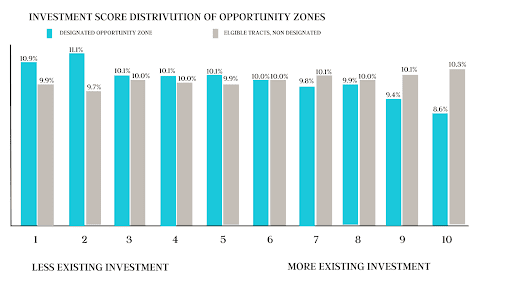
Source: Urban Institute analysis 2011-2015
CONCLUSION
Regarding the taxes that must be paid on a successful sale, one of the major advantages of a commercial real estate investment is the way that it is taxed. In the wake of the Tax Cuts and Jobs Act of 2017, a list of economically underprivileged areas known as “Opportunity Zones” was created. By reducing their capital gains taxes, investors were encouraged by the measure to place money in these zones. Taxes were fully erased after ten years of holding the investment. Selling various assets with capital gains, such as stocks or bonds, might result in an investment in an Opportunity Zone.
As informed investors, we should understand the risks associated with real estate investing and that there is no guarantee. Please do your due diligence.