
A real estate asset’s daily operations are overseen by a property manager. A property management company is in charge of managing the facilities, keeping the building in good condition, collecting rent, paying operating costs, and creating property-level financial statements for the property owner in a traditional real estate asset, like an office building or retail shopping center.
A management business at a senior living home has the extra duty of looking after the residents and advertising to the neighborhood to keep occupancy levels high. The term “senior living operator” refers to the corporation that manages the enterprise.
Owners of senior housing facilities may hire an operator as a fee manager or a triple-net (NNN) lease manager (also called a tenant operator).
What Terms Of Payment Do Owners And Operators Of Senior Living Properties Have?
Under a fee management arrangement, the property owner pays the senior living operator a fee, often a percentage of the total income, in exchange for the operator’s services. The fundamental issue with a fee manager’s compensation plan is that the operator is primarily motivated to boost top-line income rather than necessary recurrent operational profitability at the bottom line. In other words, it is feasible for the fee manager to raise running costs more than revenues, which would raise the manager’s fee while decreasing owner profitability.
For instance, a fee manager at a senior care facility with low occupancy may recruit more caregivers to improve care quality and more marketing personnel to boost the census. Yet it’s possible that even if the money from these initiatives grows, the operational costs climb too, which would leave the owner with a net loss of profitability.
The operator, as the tenant, would pay the building owner to rent under a NNN lease arrangement to run the facility as previously stated. Only if the facility generates enough cash flow for the tenant operator to pay rent and keep a portion of the operating profit for themselves, is the NNN lease arrangement practical.
In Comparison To Triple-Net (NNN) Leasing Managers, Fee Managers
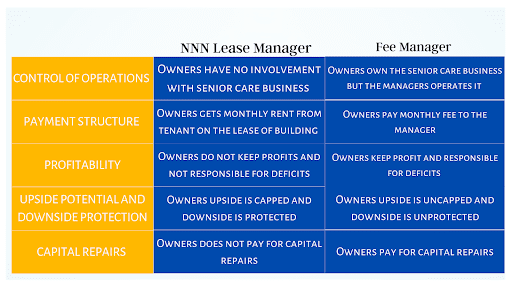
The primary difference between a fee management structure and a NNN leasing arrangement is who manages the senior housing and care business operations.
The property owner pays an operator a fee to handle the senior living operations on its behalf according to the fee management structure. The NNN lease agreement makes the operator the building’s tenant, who is liable for base rent as well as any other real estate-related expenses. The owner in this instance receives a rent check each month but is mostly uninvolved in the elderly residents’ care.
With a fee management system, there is an opportunity for the owner to exert additional control over the administration of the property. The facility’s bottom line profitability may not ultimately be the manager’s responsibility because they only get a defined salary. Hence, in some circumstances, the owner may require or ask the management to manage the facility in a specific manner. On the other hand, a NNN tenant operator is in charge of profitability; as a result, the property owner has no control over how the facility is run.
The Viewpoint Of A Property Owner About Organizational Structures
Which Senior Housing Property Management Model Is Best?
You’ll discover that some senior living operators demand a management fee while others prefer a lease when you start your search for the best operator. A management fee is frequently preferred by managers since it reduces the risk of operational losses and capital expenditures. For essentially the same reason, owners could choose a NNN tenant operator.
When selecting an organizational structure for managing senior homes, there is no right or wrong choice. Your knowledge, preferred level of engagement, and tolerance for risk and return as a property owner should guide your choice.

What Does A Manager At A Senior Living Community Do?
At a senior residential facility, tasks are managed by a senior housing manager. Senior housing property managers must prioritize resident happiness, just like typical property managers do. They achieve this by placing a high priority on personnel retention, property upkeep, and boosting NOI (net operating income).
Senior property managers, however, have extra duties that are specific to assisted living facilities.
Senior property managers are responsible for the following specific tasks:
- Directing caregivers to secure residents’ security and welfare.
- Organizing the kitchen staff to adhere to dietary restrictions and the requirements of the resident food plan.
- Arranging everyday programs and optional events for the residents’ pleasure.
- Managing payroll for employees and employing qualified personnel.
- Interacting with residents’ relatives on their health, well-being, and rent obligations.
How Does One Become A Manager Of Senior Housing?
You must first obtain a license as an assisted living administrator before you may manage senior homes. Check your state’s regulations because the process for obtaining this license differs from state to state.
A 24-hour classroom course is often required to become a licensed administrator of an assisted care facility. The license frequently has to be renewed annually as well. There are typically both in-person and online courses available, with prices ranging from $100 to $300.
As informed investors, we should understand the risks associated with real estate investing and that there is no guarantee. Please do your due diligence.
How do property managers cater to the unique needs of senior residents in housing communities?
Property managers in senior living housing communities strive to create an environment that promotes independence, safety, and a high quality of life for seniors. They provide accessibility features, organize social activities, and ensure the availability of necessary amenities and services.
What are the primary responsibilities of property managers in senior living housing communities?
What are some key challenges in property management for senior living housing communities?
How can property managers ensure the safety and well-being of residents in senior living housing communities?
Property managers ensure the safety and well-being of residents by maintaining regulatory compliance, implementing emergency preparedness plans, conducting regular inspections, addressing repairs and maintenance issues promptly, and coordinating with local authorities and emergency services.