
What Is Leverage?
Leverage is the use of various financial instruments or borrowed capital, in other words, debt to increase the potential return of an investment. Leverage is a technique used by both people and companies to expand the potential for returns, while equally expanding the downside of any risks involved if things don’t work out.
Building wealth through real estate investment is crucial to providing financial freedom. To a real estate investor, leverage works to their advantage especially in the long run as the value of the property appreciates. But it can also lead to large losses in the event that asset values fall below the mortgage amount on the property.
While the potential for a good return is possible like when real estate prices rise using leverage can be a double-edged sword. That’s because it can also lead to losses if the investment moves in the opposite direction. In the case of real estate prices, losses happen when prices decline.
How to Use Leverage in Real Estate?
The most common method for using leverage in real estate is to tap into financial resources you control to put the down payment down on rental properties. For most of us, this is our primary residence. Can you use your home equity to buy a rental property? The answer is yes, but indirectly. Your lender will let you cash out your home equity to renovate your existing home, pay down debt, invest in the stock market, or use it for some other purpose.
Most lenders won’t let you take out a mortgage on the current home to explicitly buy another property. Instead, you take out a mortgage on your current home, put part or all of that money down on a rental property, and have a separate mortgage on the rental property for the remaining balance.
Ways to Access Leverage
The easiest way to access leverage is to use your own money. In the case of a mortgage, a standard 20% down payment gets you 100% of the house in which you want to live. Some financing programs let you put even less money down.
If you purchase the property as an investment, you may be in a position where your partners furnish some or even all of the money. Similarly, some sellers may be willing to finance some of the purchase prices of the property they wish to sell. Under such an arrangement, you can purchase a property with little money down and, in some cases, no money down at all.
The ability to use leverage makes real estate an attractive investment. If not for leverage, most of us would not be able to afford the homes in which we live. For institutional investors, the prudent use of leverage provides a strategic tool to gain broader exposure to different types and a greater number of investments compared to having no leverage, thereby enhancing portfolio diversification and ultimately achieving higher returns.
The Upside of Leverage
Real estate owners and developers often rely on leverage as a means to increase the potential return on investment. The reason that leverage increases returns on a property is that the cost of debt financing, such as a bank loan, is usually cheaper than the unleveraged returns a property can generate. By inserting leverage, you can take the additional return from the leveraged portion of the project and apply it to the remaining equity to enhance leveraged returns.
Leverage can lead to many potential benefits:
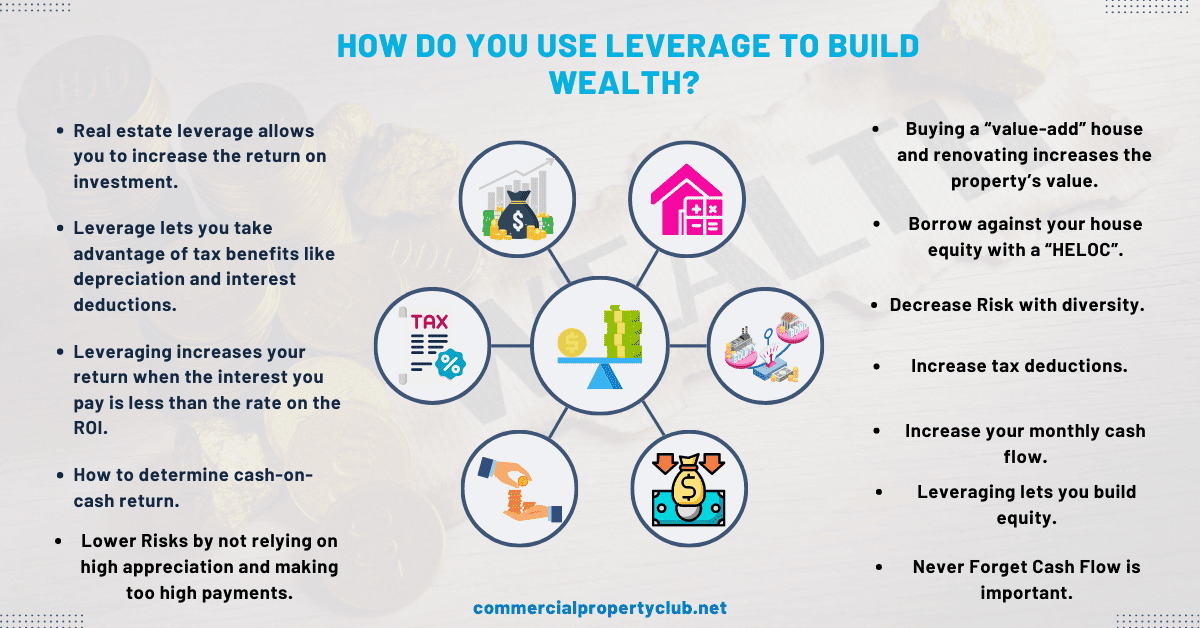
- Increased returns on investment (ROI). Investors use borrowed money to earn returns that are oversized in relation to the amount of equity they’ve invested.
- Increased cash flow. Leverage can generate higher returns than all-cash investments.
- Decreases Risk with Diversity – Leveraging allows you to buy more diverse (different classes) rental properties which insulate you from risk.
- Increased Tax Deductions – You can get mortgage payment deductions along with rental property improvements expenses tax deductions. Increase your rental investments for more deductions.
.
Risks of Using Leverage to Purchase Investment Properties
What are the downsides of using leverage in real estate? Leveraging real estate to build wealth sounds perfect, but it comes with risks. The greatest risk of leveraging real estate is that you may end up losing everything, including your own home if you make a mistake. A common mistake when leveraging real estate to build wealth is focusing on the house and not the cash flow. The goal of rental real estate is to get paying renters into the property as quickly as possible.
Financed real estate transactions increase an investor’s risk profile in several ways. Common risk factors associated with taking on debt financing include:
- Amount of leverage
- Interest rate
- Debt and valuation
Investors can manage these risk factors at both the portfolio and property levels. Staying within a predetermined leverage profile can help investors from becoming overleveraged to the point where they are unable to maintain monthly principal and interest payments.
How Equity Builds
Building your equity is a huge advantage with leveraging. When you complete your first purchase the cash you put up (down payment) becomes your equity. Over time, each monthly payment brings down the principal on your loan. Thus, you build equity that your tenants pay for.
CONCLUSION
Understanding the power of leverage and how to use it in real estate isn’t just for seasoned investors. It is possible to earn significant profits or steady cash flow when you leverage real estate. Taking advantage of leveraging real estate through financing a property can be a sound investment strategy. Holding onto your leveraged property long-term may not only produce excellent returns but monthly cash flow as well.
However, there is risk involved with such projects beyond going into debt. Make your decisions with care and caution and walk away from deals that don’t have enough margin, so as to not go bankrupt or lose everything you have.
As informed investors we should understand the risks associated with real estate investing and that there is no guarantee. Please do your due diligence.
What Is Leverage?
Leverage is the use of various financial instruments or borrowed capital, in other words, debt to increase the potential return of an investment. Leverage is a technique used by both people and companies to expand the potential for returns, while equally expanding the downside of any risks involved if things don’t work out.
What are the potential benefits of Leverage?
- Increased returns on investment (ROI). Investors use borrowed money to earn returns that are oversized in relation to the amount of equity they’ve invested.
- Increased cash flow. Leverage can generate higher returns than all-cash investments.
- Decreases Risk with Diversity – Leveraging allows you to buy more diverse (different classes) rental properties which insulate you from risk.
- Increased Tax Deductions – You can get mortgage payment deductions along with rental property improvements expenses tax deductions. Increase your rental investments for more deductions.
How can investors mitigate the risks of using leverage in commercial real estate investing?
Investors can mitigate the risks of using leverage by thoroughly researching the property and market before investing, ensuring that the property generates sufficient income to cover the mortgage payments, and having a contingency plan in case the property does not appreciate in value as expected. It’s also important to work with a qualified team of professionals, including a real estate agent, lender, and attorney, to help navigate the complex process of investing in commercial real estate with leverage.