
Commercial real estate investing is a smart way to generate passive income. There are many different types of commercial real estate, some may require a bigger investment, while others may be more time-consuming. Meanwhile, there are endless ways to generate passive income, but they are not all lucrative.
What is Passive Income?
Passive income is money that does not require much or any daily effort to earn and maintain. Some examples include stocks, renting out a property, or selling ad space in a blog. Some forms of passive income, like the latter example, may take time to build and establish. The goal is to set up a steady stream of income that you can maintain without much effort in the long run.
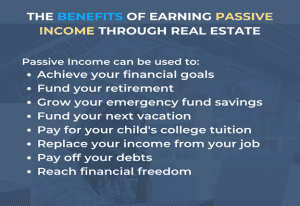
THE BENEFITS OF EARNING PASSIVE INCOME THROUGH REAL ESTATE
The benefits of passive income may seem obvious, we all need to earn a living, and as such, many of us are often looking for ways to increase our cash flow. No one can deny the appeal of earning money while you sleep.
What is residual income?
Residual income is the amount of money an individual or business has left after paying all expenses. Personal residual income is any remaining money after an individual pays all housing, food, and other expenses and pays off debts. A company’s residual income is the capital left over after they complete all their financial obligations, such as the cost of raw materials and utilities. It signifies and is utilized to measure, the performance of a business, a department within it, or even certain investments made by it.
Overall, the more residual income you have, the more financial freedom you have to achieve personal financial goals or scale your employer’s business and make choices that benefit internal and external stakeholders, such as investors or employees. Residual income can help you set attainable financial goals and budget money wisely. Both professional organizations and individuals can calculate and analyze their residual income.
How to invest in real estate for passive income
Passive real estate investing is likely the best option for people without the experience or desire to actively manage real estate properties. You can invest in real estate and build passive income streams without getting your hands dirty. There are many different options for getting started. You can find rental property opportunities by investing in single-family homes, multifamily apartments, and commercial properties such as retail shopping centers, office buildings, industrial warehouses, and other rental properties.
Here are the most common ways real estate investors create passive income streams:
1. Private real estate investment funds
Private real estate investment funds allow individual investors to pool their money with other investors to purchase multiple commercial or residential investment properties. You can leverage industry experts, experienced property managers, and proven real estate syndicators by investing in a private investment fund. These private investment funds are led by experienced managers that develop and execute an investment strategy.
This fractional ownership of real estate properties within a private fund is similar to investing in a mutual fund that provides partial ownership of multiple companies. Depending on the fund these properties can be spread across different geographic markets, and commercial or residential rental property types, allowing for greater diversification. Before investing, you’ll want to research the fund to understand its management approach, historical returns, and overall business model to make sure they align with your financial goals.
2. Purchasing private rental properties
It is possible to create real estate passive income from purchasing an investment property and then hiring a property management company to operate the business. This option allows investors to own rental income-generating real estate, but the amount of active effort required will depend on your trust in the property management company.
It is essential to remember that purchasing a property will often require larger amounts of financed capital, leaving you tied to a single property with less opportunity for diversification when compared to fractional real estate investments.
3. (Real Estate Investment Trusts) REITs
REITs, or real estate investment trusts, are large-scale companies that own, finance or operate income-producing real estate properties. These companies invest in various types of real estate properties and infrastructure, paying out their profits to shareholders through dividends.
REITs are commonly publicly traded, allowing people to buy and sell them like stocks, making them very liquid real estate investments. But, this also leads REITs to have a higher correlation to the stock market than direct ownership of private real estate. For many investors, this limits the benefit of REITs as it is harder to consider them a diversified income stream separate from stock investments.
4. Hard money lending
If you have good cash but don’t want to invest in your deals, you can become a hard money lender. Numerous real estate investors take help from hard money when they cannot gain a bank loan or when they want money in a short time. Further, hard money is also an option for investors looking for rehab and flipping the house quickly.
The hard money lenders charge the borrower an upfront fee along with 10-12%+ annual interest on the loan. This isn’t a bad deal, but you must be careful with the lending scenario to know you are not only lending money to a good borrower but also for a successful project.
5. Owner financing
If you don’t want to run a project of your own, you can become a lender for someone else’s project. Just like hard money lending, you will help a borrower get an adequate loan for his real estate investment. It is an excellent choice for those who already own real estate as it will help maintain that passive income and avoid paying any hefty taxes.
6. Real Estate Syndications
Unlike REITs, with real estate syndications, you are not investing in a fund; instead, you buy a specific real estate property and become an owner of the asset. As the owner of the real estate asset, you have more opportunities to increase your tax benefits as a passive investor.
In summary, a real estate syndication involves multiple investors pooling their capital to purchase a real estate asset. The general partner, or syndicator, of the real estate syndication, finds a deal, coordinates the transaction and financing, and manages the investment once it has been finalized. Passive investors pitch in most of the capital required in exchange for equity in real estate. In real estate syndications, passive investors don’t have to be actively involved in property management, accounting, or tenant-related issues.
Conclusion
Given all the available choices, choosing the right one for your passive real estate investment can be challenging. Investing in real estate is a great opportunity for those who are looking to take advantage of the profits real estate can yield without actively managing day-to-day operations. Before jumping into passive income investing, connect with an expert in the space and continue your education on each of the investment vehicles mentioned above.
As informed investors we should understand the risks associated with real estate investing and that there is no guarantee. Please do your due diligence.
What is residual income?
Residual income is the amount of money an individual or business has left after paying all expenses. Personal residual income is any remaining money after an individual pays all housing, food, and other expenses and pays off debts. A company’s residual income is the capital leftover after they complete all their financial obligations, such as the cost of raw materials and utilities. It signifies and is utilized to measure, the performance of a business, a department within it, or even certain investments made by it.
What is the difference between commercial and residential real estate investing?
Commercial real estate investing involves the purchase and management of properties that are used for business purposes, such as office buildings, retail spaces, and industrial warehouses. Residential real estate investing, on the other hand, involves properties that are used for living purposes, such as apartments, condos, and single-family homes.
How do I finance a commercial real estate investment?
Financing options for commercial real estate investments include traditional bank loans, commercial mortgage-backed securities, and private equity investments. It’s important to shop around for the best rates and terms, and to have a solid business plan in place before applying for financing.