
Opportunity Zones provide special benefits to both communities and investors, encouraging construction in underdeveloped regions by providing tax breaks to investors. Yet, not every Opportunity Zone fund is the same.
Opportunity Zones are a mechanism for economic development that let investors put money into struggling American neighborhoods. Its goal is to promote economic development and job creation in low-income areas while giving investors tax advantages.
WHAT ARE THE ADVANTAGES OF APARTMENT DEVELOPMENT IN “OPPORTUNITY ZONES”?
-
Straightforward Tax Reporting
Taxes are only disclosed on Form 1099-DIV and only in years where we pay distributions since the fund is set up as a REIT (Real Estate Investment Trust). Investors in a commingled limited partnership have a high tax reporting burden since they get a K-1 and must file state-level tax returns in each state where the fund has made investments. Only 1099s are submitted for federal purposes and only the state in which the investor resides receives 1099s.
Source: Downtown development opportunity
-
Investment Tax Breaks In Non-Compliant States
Investors will often be forced to pay state taxes to that state, even on the post-10-year realization, if a partnership-based QOF (Quality and outcomes framework) invests in a state that is “non-conforming,” meaning that its state tax rules do not provide for the QOZ (Qualified Opportunity Zone Property) advantages. Investors are only obliged to pay taxes in their own state by restricting our reporting to a 1099-DIV. As a result, investors who reside in “conforming” or non-tax states will not be obliged to account for taxes in non-conforming jurisdictions where our QOF(Quality and outcomes framework) makes investments (California, New York, and North Carolina).
-
The Ability To Better Leverage
The reduction of capital gains taxes is one of the investment’s main advantages. We can internalize depreciation through the REIT (Real Estate Investment Trust) structure to offset revenue and eliminate the need for net income distributions, choosing tax-advantaged return of capital distributions instead. No matter the structure, every dollar given to fund investors as taxable income lowers the fund’s potential for tax-free development. Moreover, we can make sure that more investment dollars take full advantage of the 10-year capital gains exclusions thanks to internally recorded depreciation inside the fund.
-
More Flexible Investing Options
We can control the tax consequences of our investments more effectively thanks to the REIT structure. The idea that all properties in a QOF(Quality and outcomes framework) must be kept for 10 years to receive tax benefits is a common misunderstanding in opportunity zone investing. This is false since the investor who owns shares in the QOF is the one who is subject to the limitation. Every asset sale in a QOF(Quality and outcomes framework) that is set up as a partnership must be passed through to investors; if this happens before year ten, significant tax advantages will be lost.
The only way for a partnership to sell a property and maintain the benefits for investors is thus through a 1031 exchange, which can be challenging to complete in a QOF(Quality and outcomes framework) owing to the program’s restrictions. With the REIT (Real Estate Investment Trust) structure, we are still able to sell a property and complete 1031, but we also have the choice to pay taxes on the gain from the asset’s disposition and reinvest the remaining money. This will give the capital another chance to increase within the fund and, in the end, will result in a bigger back-end benefit.
Who Is Eligible to Benefit from Qualified Opportunity Zones?
- Individuals Corporations
- Real estate investment trusts and partnerships (REITs)
- other pass-through organizations, including trusts and estates

How Do Opportunity Zones Work, Who Can Request The Incentives, And What Projects Can They Support?
Opportunity Zones, a new federal incentive included in the Tax Cuts and Jobs Act, are designed to encourage investment in underfunded communities. Any business or person with capital gains is eligible. Unrealized capital gains have three tax advantages when invested in Opportunity Zones under the program:
-
Temporary Postponement Of Taxes On Capital Gains That Were Previously Earned
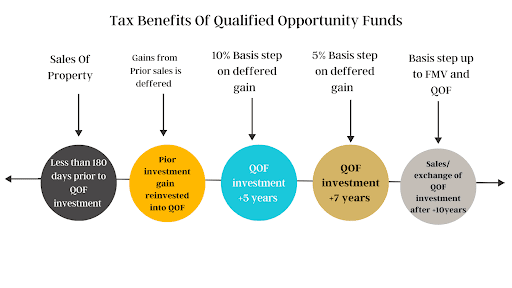
Existing assets with capital gains can be invested in Opportunity Funds by investors. These current capital gains are not subject to taxation until 2026 ends or the asset is sold.
-
Basis Raising For Previously Accumulated Capital Gains.
Investors’ basis on the initial investment rises by 10% for capital gains held in Opportunity Funds for at least 5 years. Investors’ base on the initial investment rises by 15% if held for at least 7 years.
-
Permanent Exclusion Of Fresh Gains From Taxation.
Investors who invest in Opportunity Funds, the investment vehicle that makes investments in Opportunity Zones, pay no taxes on any capital gains generated by such investments for investments held for at least ten years.
Investors can benefit from one or more of the advantages.
Opportunity Funds can provide funding for a wide range of initiatives and projects, with the exception of a few “sin” firms. Money can be used to fund homes, infrastructure, current or new enterprises, as well as commercial and industrial real estate. Real estate projects must “substantially improve” the properties in order to be eligible for Opportunity Fund financing.
What Are The Zones’ Communities And Characteristics?
Opportunity Zones make for 8.762 percent of US census tracts. The zones were legally recognized by the US Department of the Treasury after being nominated by the governors of the 50 states, 4 territories, and the city of Washington, DC. There is no provision in the Act to alter the designation of localities as Opportunity Zones.
According to studies by the Urban Institute, compared to eligible nondesignated tracts, the designated zones had lower incomes, greater rates of poverty, and higher rates of unemployment. Analysis, however, reveals that the initiative only barely targets neighborhoods with low levels of investment.
Urban scored Opportunity Zone investment on a scale of 1 to 10, with 10 being the highest score, standard across all qualifying tracts state by state. The three tracts with the least investment account for little under one-third of Opportunity Zones, while the three tracts with the highest investment account for 28 percent.
CONCLUSION
For investors, qualified opportunity zones provide a variety of advantages, most notably tax advantages that can reduce operating costs and increase returns. Deferring tax payments on prior capital gains is one of the main advantages of qualified opportunity funds.
Investors can move the profits from another investment to an opportunity fund within 180 days of the sale date to postpone paying taxes rather than collecting capital gains. Payments may be postponed until either the sale of the opportunity fund or December 31, 2026, whichever comes first.
As informed investors, we should understand the risks associated with real estate investing and that there is no guarantee. Please do your due diligence.